

What if beneath Cusco there’s an underground world that most people will never see?
Hidden below iconic sites like Sacsayhuamán, the so-called Inca tunnels in Cusco remain one of the most intriguing mysteries of the Inca Empire. Some theories suggest they may connect important temples like Qoricancha, while others point to ritual uses deeply rooted in Andean cosmology.
In my case, after stepping into one of these tunnels and moving forward in complete darkness, I realized this isn’t just history—it’s something you can actually experience.
What Are the Inca Tunnels in Cusco?
The Inca tunnels in Cusco, commonly referred to as chinkanas, have long attracted attention from both local tradition and archaeological research. While popular narratives describe vast underground networks beneath the entire city, scientific evidence suggests a more specific and limited reality.
According to archaeological studies, these structures are primarily found in key ceremonial and administrative sites, particularly around Sacsayhuamán. However, there is no conclusive evidence of a continuous underground system connecting all of Cusco.
Instead, researchers interpret these constructions as isolated subterranean spaces, designed for specific purposes rather than large-scale transportation networks.
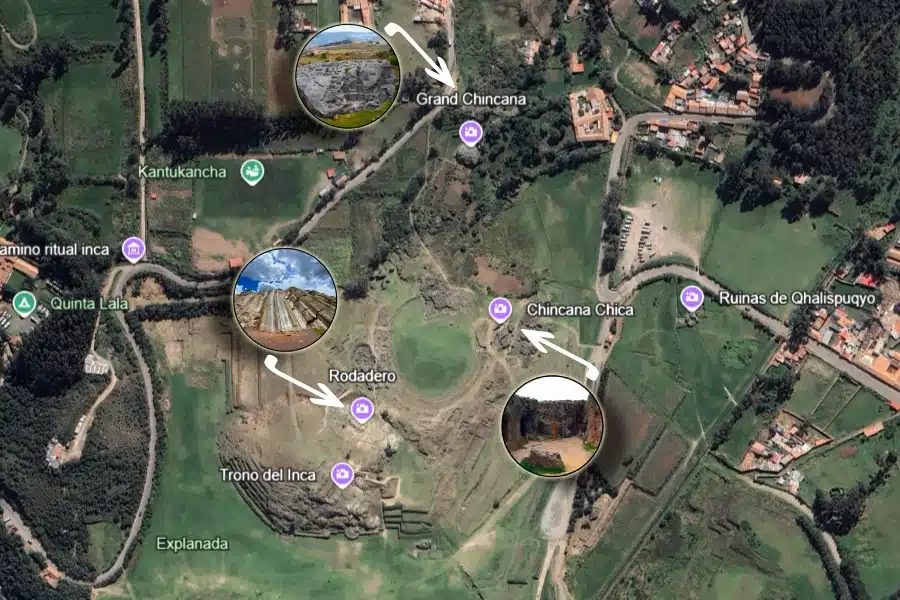
Map of Sacsayhuamán showing where the Chinkana tunnels are located within the archaeological site.
The Chinkana: The Most Mysterious Underground Structure
From an archaeological perspective, chinkanas are not simply tunnels—they are engineered underground spaces integrated into Inca architectural design.
The word chinkana comes from Quechua and is often translated as “labyrinth” or “a place where one gets lost,” which accurately reflects their nature.
Chinkana Grande vs Chinkana Chica
- Chinkana Grande: A larger and more complex underground structure, currently closed to the public due to safety concerns. It is located a short distance from the smaller tunnel and is sometimes referred to locally as Piedra Cansada.
According to local accounts, this is the section most associated with long-standing legends, including stories of people getting lost inside its deeper passages.
- Chinkana Chica: A smaller and more accessible tunnel, located near the Suchuna area (also known as “El Rodadero”), approximately 150 meters away. Its route is relatively short, which is why it has been opened to visitors.
Despite its size, it still offers a clear sense of the darkness and confined structure typical of these underground spaces.
In my case, I was able to enter the Chinkana Chica inside Sacsayhuamán, which was enough to understand the nature of these spaces.
Why Are the Chinkanas Considered Dangerous?
These structures present very specific characteristics:
- Total darkness
- Narrow passages
- Disorienting layout
Historical accounts and local reports suggest that people who entered larger tunnel systems in the past often became lost. For this reason, access to the more complex structures has been restricted.
From a technical perspective, this indicates that these spaces were likely not designed for regular movement, but rather for controlled or restricted use.
My Experience Inside the Chinkana
Entering the chinkana is completely different from visiting any other archaeological site in Cusco.
In my experience, once inside the Chinkana Chica, visibility disappears almost instantly. There is no natural light, and within seconds you are forced to rely entirely on your sense of touch.
I had to move slowly, using my hands to feel the walls and guide myself forward. At that moment, it became clear that I wasn’t simply walking—I was navigating an unfamiliar space without visual references.
This experience strongly suggests that these environments were not intended for frequent or casual use, but rather for specific, possibly ritual or restricted purposes.
As far as I could confirm, this is currently the only chinkana open to visitors.
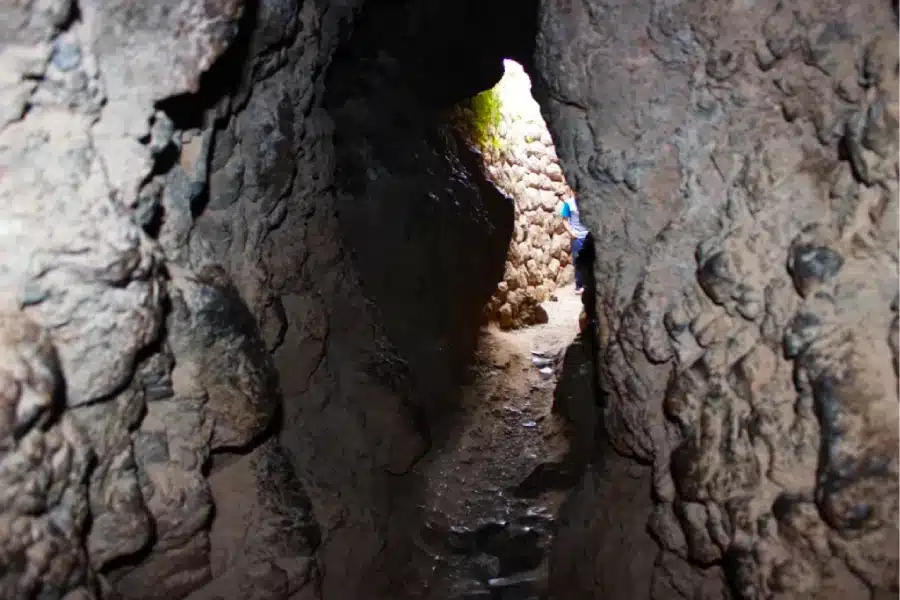
Inside the Chinkana Chica tunnel, visitors experience darkness and narrow underground passages.
Are There Underground Tunnels Beneath All Cusco?
One of the most widespread beliefs is that an extensive network of tunnels runs beneath the entire city of Cusco.
However, from an archaeological standpoint:
- No complete underground network has been confirmed
- There are no verified maps of interconnected tunnels
- Excavations have revealed localized structures, not large systems
That said, colonial-era chroniclers did mention underground passages, which has helped keep this theory alive in both academic discussions and popular imagination.
Do the Inca Tunnels Connect to Qoricancha?
This is one of the most persistent and fascinating theories.
It has been suggested that underground passages may connect Sacsayhuamán with Qoricancha, the most important temple of the Inca Empire.
From an academic perspective:
- There is no conclusive archaeological evidence supporting this connection
- The idea is largely based on historical accounts and oral traditions
- Some researchers believe it may have been symbolic or exaggerated over time
However, the fact that multiple sources reference underground spaces in key locations suggests that these structures played an important role—though not necessarily as a connected network.
Why Did the Incas Build Underground Spaces?
Archaeologists have proposed several interpretations:
Ritual Use
Connected to Ukhu Pacha, the underworld in Andean cosmology.
Restricted Access
Spaces likely reserved for specific individuals or purposes.
Storage or Protection
Possibly used to safeguard valuable or sacred objects.
Symbolic Meaning
The Incas had a deep spiritual relationship with the earth, and underground spaces may have held symbolic significance.
Most likely, these structures served multiple functions depending on their context.
Can You Visit the Inca Tunnels Today?
Yes—but only in a limited way.
Currently, the only accessible structure is the Chinkana Chica in Sacsayhuamán.
Based on my experience, this is not a typical tourist attraction:
- There is no lighting
- The space is narrow
- Movement requires caution
However, that is precisely what makes it one of the most authentic and memorable experiences in Cusco.
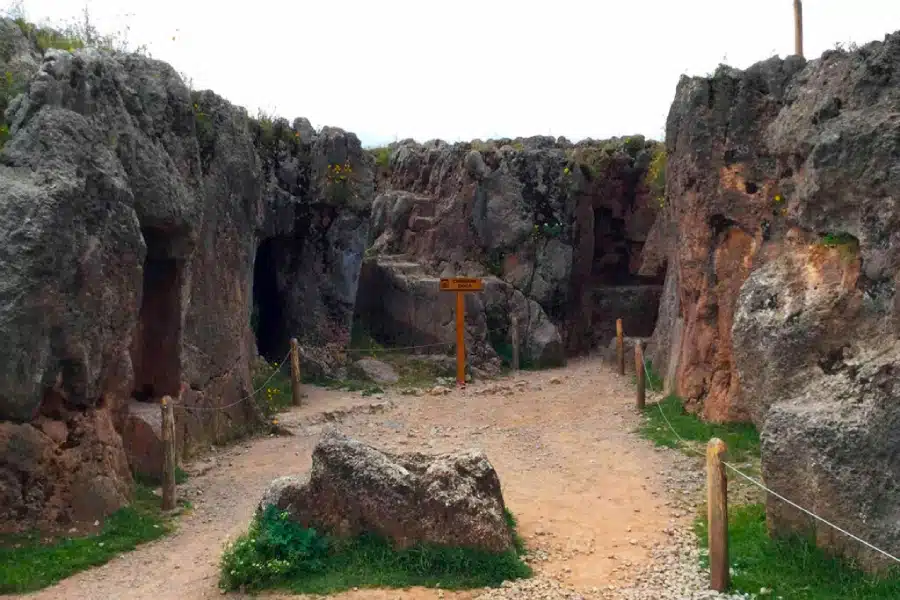
Entrance to the Chinkana Chica, the only Inca tunnel in Sacsayhuamán accessible to visitors.
Hidden Stories and Legends About the Inca Tunnels in Cusco (Chinkana)
Beyond archaeological interpretations, the Chinkana tunnels in Sacsayhuamán are surrounded by some of the most fascinating legends in Cusco.
According to local traditions, these underground spaces—often described as labyrinths carved into limestone—may extend far beyond what is visible today. Some stories even suggest that the tunnels could connect important sites such as Sacsayhuamán and Qoricancha, located in the historic center of Cusco. However, there is no archaeological evidence confirming a continuous underground network.
There are two main chinkanas in the area. The Chinkana Chica, which is open to visitors, offers a short and controlled experience. The Chinkana Grande, on the other hand, remains closed—and it is this larger structure that has inspired many of the most persistent legends.
One of the most well-known stories tells of explorers who entered the Chinkana Grande equipped with ropes and candles, only to disappear for months. According to the legend, one of them later emerged inside what is now the Santo Domingo church, reportedly holding a solid gold corn cob. While this story is widely shared in local culture, it should be understood as part of Cusco’s oral tradition rather than verified history.
Other accounts describe strange experiences inside the tunnels, including disorientation, unexpected obstacles, and a strong sense of losing direction. Some early 20th-century expedition stories even claimed that explorers became mentally affected after entering these underground spaces, though these reports are not supported by modern archaeological research.
These narratives, while not scientifically confirmed, reflect the powerful role that the Chinkana plays in the cultural imagination of Cusco—somewhere between history, myth, and mystery.
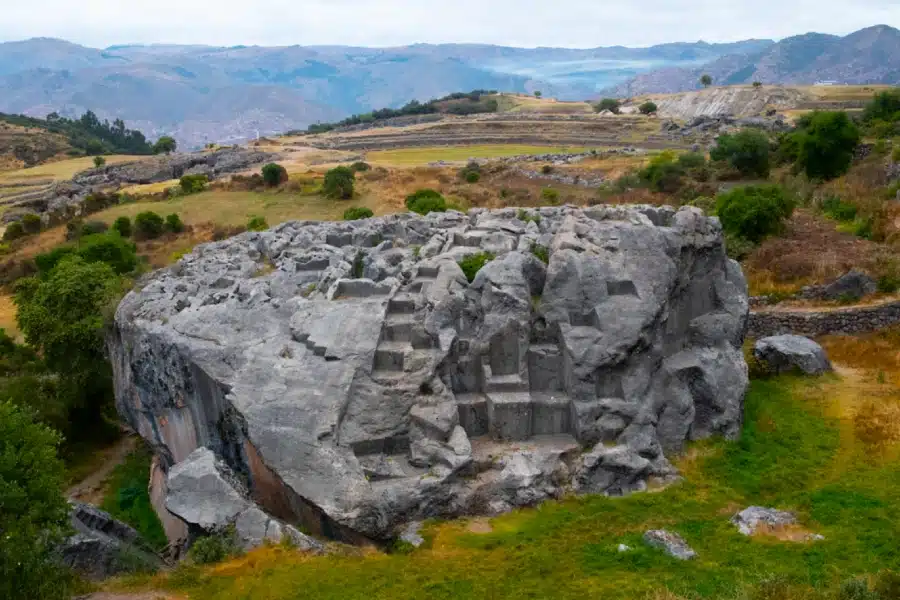
Chinkana Grande in Sacsayhuamán, a larger underground structure closed to the public and associated with local legends.
Tips for Visiting Sacsayhuamán and the Chinkana
- Visit during daylight hours
- Move slowly inside the tunnel
- Avoid entering if you feel uncomfortable in enclosed spaces
- Consider visiting with a guide for historical context
You might be interested in the guided Cusco City Tour, which includes a visit to Sacsayhuaman.
Final Thoughts: Between History and Mystery
The Inca tunnels in Cusco exist at the intersection of archaeology and mystery.
We know they are real. We know they were important. But their full purpose remains uncertain.
In my case, even a brief experience inside the chinkana completely changed how I see Inca engineering. It’s not only about what they built above ground—but also what they created beneath it.