
Rising high above the Vilcabamba mountain range in southern Peru, Salkantay Mountain is one of the Cusco region’s most impressive peaks. At 6,271 meters (20,574 feet), its snow-covered summit dominates the surrounding landscape and has long held a deeper meaning than its impressive height suggests.
For travelers, Salkantay is best known as the mountain encountered along the famous Salkantay Trek to Machu Picchu. But the mountain itself has a much older cultural significance. In the Andean worldview, Salkantay is regarded as an Apu, a sacred mountain associated with the landscape, water, protection and ancestral traditions.
Understanding this spiritual dimension offers a different way to experience the Salkantay region—not simply as a spectacular trekking destination, but as a living Andean landscape.
What Is Salkantay Mountain?
Salkantay Mountain, also known as Mount Salkantay, is one of the highest mountains in the Cusco region and part of the Vilcabamba mountain range in the Peruvian Andes. Its summit reaches approximately 6,271 meters (20,574 feet) above sea level, making it a striking presence among the surrounding peaks.
The mountain lies northwest of Cusco and forms part of the dramatic landscape between the Cusco highlands and the cloud forests leading toward Machu Picchu.
Its steep slopes, glaciers and surrounding valleys create a landscape of remarkable contrasts. Within a relatively short distance, travelers can encounter high-altitude mountain environments, turquoise glacial lakes, grasslands and increasingly warmer ecosystems as the terrain descends.
💡 Did You Know?
Salkantay rises more than 6,200 meters above sea level, making it one of the highest peaks in the Cusco region.
What Does Salkantay Mean?
The name Salkantay is associated with the Quechua word sallqa, generally connected with ideas such as wild, untamed or uncultivated.
However, the exact meaning and etymology of the full name should be treated with some care. Travelers may encounter different interpretations when researching Salkantay, and not every popular translation has the same linguistic or historical basis.
What is clearer is the association between the mountain and the idea of a powerful, wild Andean landscape. This interpretation fits the character of Salkantay itself: a massive, remote mountain surrounded by glaciers, high valleys, and rugged terrain.
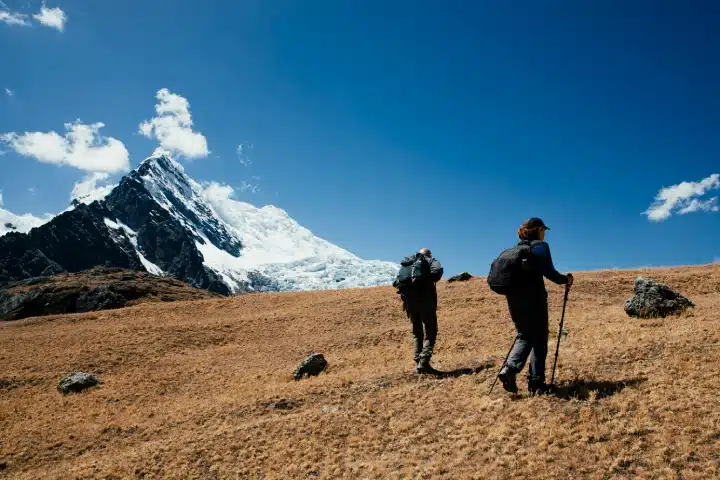
Hikers exploring the high-altitude landscapes of the Andes.
Quick Fact
You may also see the mountain written as Salcantay or Sallqantay. These variations refer to the same mountain and reflect different ways of representing the Quechua name.
What Is an Apu?
To understand why Salkantay is spiritually important, it helps to understand the concept of an Apu.
In Andean culture, certain mountains are regarded as powerful spiritual beings or sacred entities connected to the territory and the communities that live around them. These mountains are commonly referred to as Apus.
The concept goes beyond simply considering a mountain sacred. An Apu can be understood as part of a broader relationship between people, landscape, water, animals, agriculture and the natural world.
For Andean communities, mountains have traditionally been associated with protection and the well-being of the surrounding territory. Their glaciers and waters are also closely connected to life in the valleys below.
Salkantay is one of the mountains that occupies this important place in the Andean worldview.
Why Is Salkantay Considered a Sacred Mountain?
Salkantay’s importance comes not only from its impressive size. Its relationship with the surrounding landscape and water has contributed to its spiritual significance.
In the Andes, high mountains are closely connected with sources of water. Snow and glaciers feed rivers and streams that eventually reach lower valleys, supporting agriculture, ecosystems and communities.
This relationship helps explain why mountains could be understood as powerful presences rather than simply geographical features.
Academic research on Salkantay has examined the mountain through concepts including landscape, power, water and ancestors, showing that its significance forms part of a broader Andean cultural system.
The mountain’s sacred character is therefore connected to the landscape around it—not isolated from it.

Spectacular snow-capped peaks of the Peruvian Andes.
💡 Did You Know?
In the Andean worldview, a mountain can be more than a physical landmark. An Apu may be understood as a powerful presence connected to territory, water and the people who depend on it.
Salkantay and the Andean Worldview
The spiritual meaning of Salkantay becomes easier to understand when viewed within the broader Andean concept of reciprocity.
Traditional Andean relationships with the natural world are often described through the principle of ayni, or reciprocity. Rather than seeing nature simply as a resource, the relationship involves giving, receiving and maintaining balance.
Mountains, water and the land therefore have an important place within this worldview.
Salkantay’s significance should also be understood as part of a living cultural landscape. Traditions can differ between communities, and contemporary practices should not be treated as if there were a single uniform Andean belief system.
For travelers, this is an important distinction. The spiritual meaning of Salkantay is not simply a historical story from the Inca period—it forms part of a much broader and evolving relationship between Andean communities and their environment.
Salkantay and Machu Picchu: A Cultural Connection
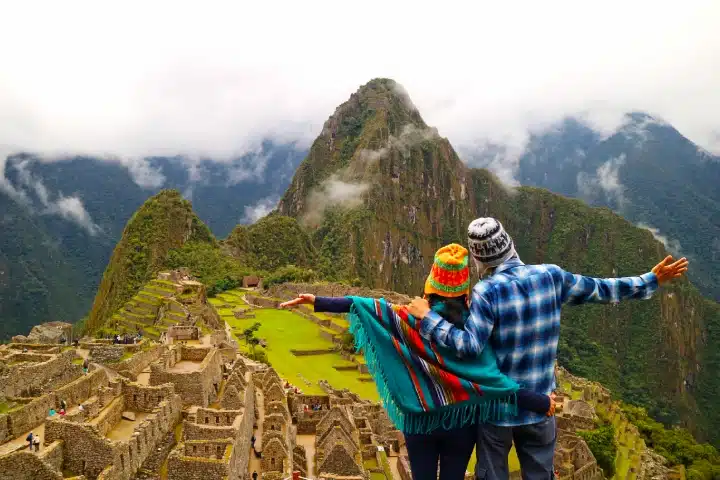
Salkantay is often introduced to travelers because of its connection with Machu Picchu and the famous trekking route between the Cusco region and the ancient citadel.
But the relationship between the mountain and Machu Picchu is more interesting than simply being part of the same trekking itinerary.
Salkantay belongs to the broader mountain landscape of the Vilcabamba region. From different locations in the area, mountains, valleys and archaeological sites form interconnected visual and geographical landscapes.
Research into the sacred landscape around Cusco and Vilcabamba has also explored the relationship between important mountains, archaeological centers, water and ancestral traditions.
This helps place Machu Picchu within a much larger Andean landscape rather than viewing it as an isolated archaeological site.
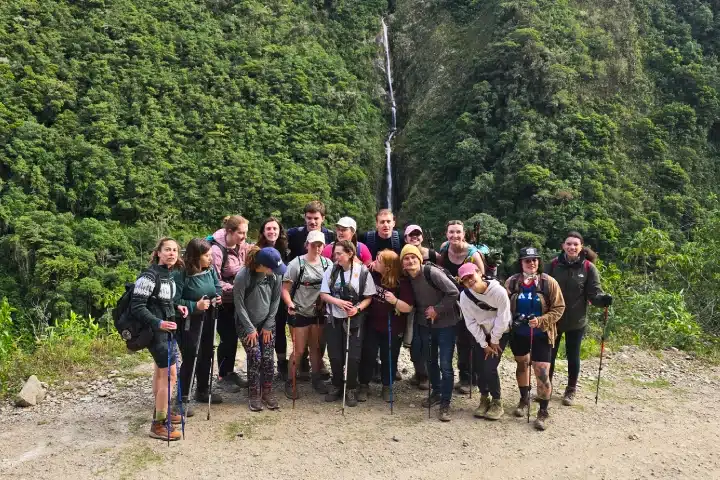
Trekkers on the Salkantay route to Machu Picchu.
Salkantay Mountain and the Salkantay Trek
Today, most international travelers encounter Salkantay through the Salkantay Trek to Machu Picchu.
The trek passes through the dramatic landscape surrounding the mountain, including high-altitude areas near Salkantay Pass before descending toward warmer valleys and eventually Machu Picchu.
However, trekking around Salkantay is very different from climbing the mountain itself. The summit reaches more than 6,200 meters, while the trekking route follows established paths through the surrounding landscape.
For travelers, this means that the Salkantay Trek offers an opportunity to experience the environment and scenery of the sacred mountain without attempting a technical high-altitude ascent.
Want to explore the region?
Discover our Salkantay Trek to Machu Picchu guide to learn about the route, altitude, itinerary, and what to expect along the journey.
What Travelers Should Know Before Visiting Salkantay
Salkantay is a high-altitude mountain environment, and conditions can change quickly.
If you are traveling through the region, keep a few things in mind:
- Altitude: The highest sections of the Salkantay Trek reach well above 4,000 meters.
- Weather: Temperatures can change significantly between high mountain areas and lower valleys.
- Preparation: Allow time to acclimatize before undertaking demanding high-altitude hikes.
- Respect: Treat local communities, archaeological sites, and culturally significant places with respect.
- Environment: Carry your waste with you and help protect the fragile high-Andean landscape.
Travel Tip
The Salkantay region can feel dramatically different from one section of the trail to another. Pack for cold, windy conditions at high elevations as well as warmer weather at lower altitudes.
Why Salkantay Still Matters Today
Salkantay is easy to recognize as a spectacular mountain. Its glaciers, altitude, and dramatic scenery naturally attract travelers from around the world.
But its importance goes beyond its appearance.
For centuries, Andean societies have understood mountains as important elements of their cultural and spiritual landscape. Salkantay continues to be associated with the concept of the Apu, connecting the mountain with territory, water, ancestral traditions, and the communities of the Andes.
For travelers, learning about this perspective can change the way they experience the Salkantay region.
The mountain is not simply the backdrop to a trek toward Machu Picchu. It is part of a much larger landscape—one where nature, culture, and history remain deeply connected.
And perhaps that is the best way to understand Salkantay: not only as one of the highest mountains in Cusco, but as a powerful symbol of the living Andean landscape.
Ready to discover the majestic beauty of Salkantay Mountain? Contact one of our advisors to check availability and plan your unforgettable journey through the Peruvian Andes.